
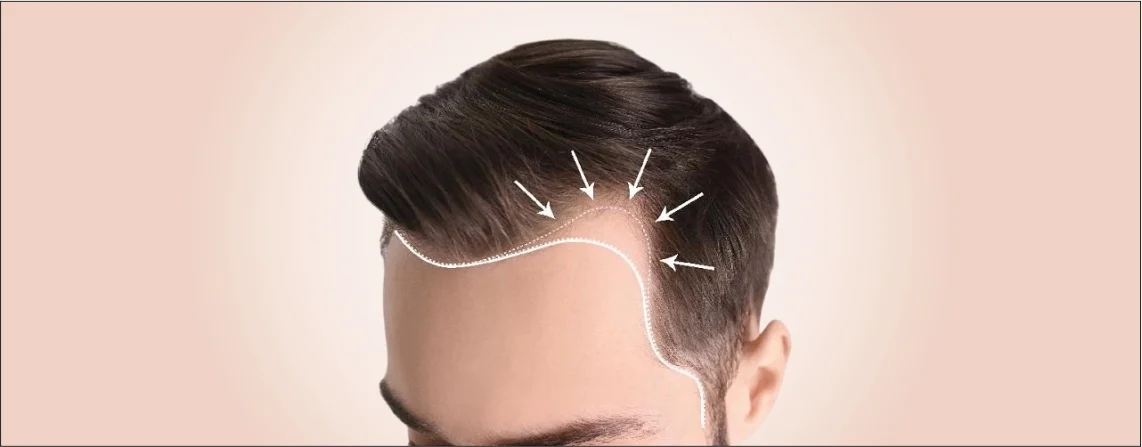
Hair Transplant for Receding Hairline: Is It the Right Solution?
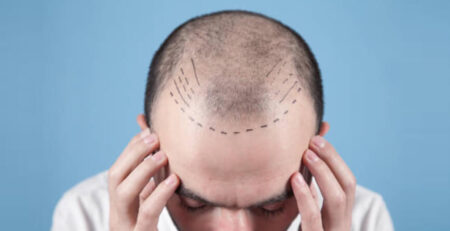
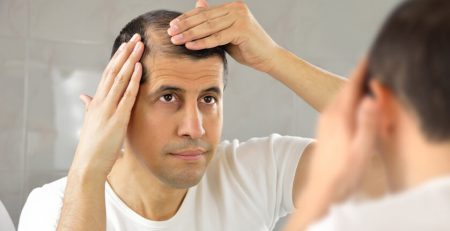
A receding hairline is among the most obvious indicators of loss of hair particularly for men. As the hairline slowly shifts backwards the forehead can appear bigger and the overall appearance of your face may alter. Although lifestyle and medication may be able to help control certain kinds of hair, they are not able to always replace hair that’s already lost. This is the reason why the Hair Transplant for Receding Line could be a good treatment option for patients carefully selected. At Med Esthetiks Dr. Lokesh Handa, an expert Plastic, Aesthetic and Hair Transplant Surgeon, analyzes the hair loss pattern and donor hair availability facial proportions, as well as the long-term goals prior to recommending the best method for hair restoration.
What Causes a Receding Hairline?
Regression of the hairline may occur due to a variety of reasons, but hair loss due to hereditary or androgenetic causes is among the most frequent causes. The genetic sensitivity to dihydrotestosterone (DHT) may gradually reduce hair follicles in the temples as well as on the frontal scalp.
Other elements that can cause hairline changes are:
- Hair loss in the family history
- Hormonal changes
- Certain medical conditions
- Nutritional deficiencies
- Stress and illnesses
- Hairstyles repeated that pull off hair
- Ageing naturally
Finding the root of the problem is essential prior to deciding on the possibility of surgery. An appointment with a certified hair transplant surgeon will help determine if the loss of hair is sufficient to be suitable for transplantation.
How Does a Hair Transplant Restore a Receding Hairline?
A Hair Transplant for Receding Hairline involves the transfer of healthy hair follicles from the donor area, usually the sides or back of the scalp, to areas affected by hair loss. The transplanted follicles can continue to grow hair in their new location, helping restore coverage and improve the appearance of a receding hairline.
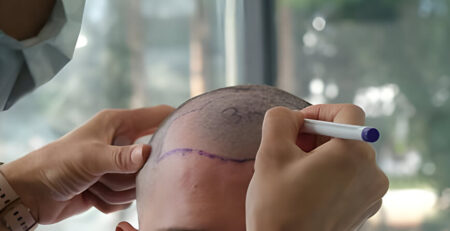
For patients with receding hairlines, close attention is paid to the frontal hairline. The surgeon considers the natural direction, angle, density, and pattern of hair growth to create a hairline that complements the patient’s facial shape and overall appearance.
At Med Esthetiks, Dr. Lokesh Handa focuses on creating natural-looking hairlines rather than simply increasing the number of hair grafts. This approach helps ensure that the restored hairline looks balanced, aesthetically pleasing, and appropriate as the patient ages.
Is Hair Transplant the Right Solution for a Receding Hairline?
For some individuals, Hair Transplant for Receding Hairline can provide a long-term solution for restoring lost hair along the frontal scalp. However, hair transplantation is not necessarily the best option for everyone. Suitability depends on the cause and extent of hair loss, donor hair availability, age, overall health, and long-term expectations.
A hair transplant could be considered in the following situations:
- The hairline is receding significantly.
- Hair loss is usually caused by genetic
- The donor region contains enough healthy hair follicles
- The patient is realistic about expectations.
- Hair loss is relatively steady
- Medically fit for the procedure.
Younger patients who experience rapid growth of hair loss might require further assessment prior to proceeding with transplantation. The hairline is not planned appropriately at an early age could cause problems if more natural hair loss happens later.
FUE and FUT for Hairline Restoration
Two proven techniques in the field of hair transplantation include Follicular Unit Extraction (FUE) and Follicular Unit Transplantation (FUT).
FUE Hair Transplant
FUE involves removing Follicular units in a single follicular unit from the donor region and implanting them in the recipient region.
Possibilities for benefit are:
- Small extraction marks
- No linear donor scar
- Hairstyles that are shorter
- Precise graft placement
- Generally speaking, it is a simple recovery
FUE is often used to treat patients looking to restore the hairline on their front.
FUT Hair Transplant
FUT consists of removing a small piece of scalp donor from the rear of the head. This is divided into follicular grafts that are individual to be transplanted.
Although FUT can leave an asymmetrical scar, it is able to provide many hair grafts for patients who are suitable. The decision between FUE and FUT is based on factors like donor density, hair type prior procedures, as well as the patient’s objectives.
Dr. Lokesh Handa has experience using both FUT and FUE techniques. He might recommend a specific technique or a combination based on the individual’s needs.
Designing a Natural-Looking Hairline
The hairline is among the most crucial aspects of hair transplantation.
Natural hairlines should not appear perfectly straight or uniform. There are usually small variations in density, height the direction of hair, as well as its follicular location.
In the course of treatment The surgeon will consider:
- Shape of the face
- Forehead height
- Age
- Existing hair density
- Hair texture
- Hair donation availability
- Future hair-loss patterns
A well-designed hairline can improve facial balance without appearing to be a transplant.
What Happens After a Hair Transplant?
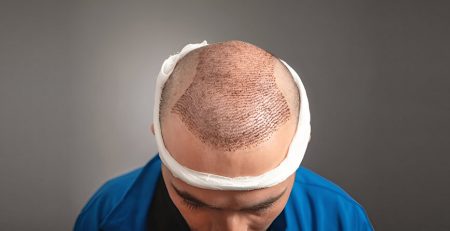
Patients must be aware that hair growth is a slow process. Hair transplanted does not instantly show its final appearance.
A few transplanted hairs might be shed for a short time during the initial weeks after the procedure. It is usually called”shock loss,” or “shedding stage and doesn’t necessarily mean that the transplant is not working.
Hair growth that is new generally grows slowly over a period of time. The improvement continues as the transplanted hair follicles grow and the final results are typically evaluated after a few months.
Follow the post-operative guidelines to protect the grafts and aiding in the recovery process.
Can a Hair Transplant Prevent Future Hair Loss?
Hair transplants can restore hair loss in areas that have been losing hair before however it does not necessarily prevent the loss of hair that has not been treated.
Patients who are suffering from ongoing genetic hair loss could have to endure losing their existing non-transplanted hair. This is why surgeons can discuss treatment options for medical conditions or other options as part of a longer-term hair loss treatment strategy.
A great treatment plan takes into account not only the hairline of the patient but also how the hair of the patient may alter in the near future.
How Much Hair Can Be Restored?
The number of grafts needed will depend on the size of the area to be treated, the degree of recession, the donor hair’s density and type and the desired amount of coverage.
A patient with a slight temple recession might require less grafts than those who had a significant loss of frontal hairline.
The objective should not just be to transfer the highest number of hair follicles. Effective utilization of the donor region and the correct graft positioning is essential to achieve visually pleasing and lasting outcomes.
Recovery After Hair Transplant
Hair transplants are usually carried out under local anesthesia. Patients might be afflicted with a redness, swelling or slight discomfort following treatment.
Recovery suggestions could consist of:
- Refrain from touching the Grafts
- Follow the recommended washing routine.
- Do not engage in strenuous activities during the suggested time
- The scalp is protected from sunburn
- Attending appointment follow-ups
The exact timeframe for recovery varies according to the treatment method employed and the specific patient.
Why Choose MED ESTHETIKS for Hairline Restoration?
Selecting the best surgeon is a crucial aspect to achieve a natural appearance. Med Esthetiks is headed by Dr. Lokesh Handa, who has extensive expertise in aesthetic surgery, plastic surgery procedures as well as hair transplantation.
Doctor. Handa has practiced internationally with over four years of practice in Dubai and has worked using FUE, FUT, combinatorial hair transplant methods as well as the use of robotics for hair transplantation. Dr. Handa has also been a part of and presented his research at international conferences as well as training courses.
For patients considering Hair Transplant for Receding Hairline, Dr. Handa focuses on creating a natural-looking hairline rather than simply increasing graft numbers. His treatment approach emphasizes patient safety, appropriate hairline design, natural aesthetics, and personalized treatment planning based on each patient’s hair loss pattern, donor area, facial features, and long-term goals.
When Should You Consider a Hair Transplant?
If you experience a gradual recession in the temples or on the frontal scalp, it’s worth seeking out a medical professional instead of relying on your own theories about the root reason.
An assessment will be used to determine:
- The kind of and degree of loss of hair
- Donor area quality
- Hair density
- If hair loss is permanent
- If a transplant is a good idea,
- How many grafts could be required?
- What long-term treatment strategies could be a good fit?
Patients seeking Hair transplants in Delhi must take into consideration the surgeon’s expertise, experience, procedure approach, standards of the facility and their ability to provide natural-looking outcomes rather than selecting the clinic solely on cost.
Conclusion
A receding hairline can significantly affect facial appearance and confidence. However, modern hair restoration can provide an effective solution for carefully selected candidates. Hair Transplant for Receding Hairline can help restore lost hair and create a more balanced, natural-looking frontal hairline when the procedure is carefully planned and performed by an experienced surgeon.
At Med Esthetiks, Dr. Lokesh Handa combines his expertise in hair transplantation and plastic surgery with a strong focus on natural aesthetics, patient safety, and personalized treatment planning. For individuals searching for the Best treatments for hair loss in Delhi, a detailed consultation can help determine whether hair transplantation is suitable for their specific pattern and stage of hair loss. It can also help identify the most appropriate technique for achieving natural-looking and long-lasting results.





Leave a Reply