
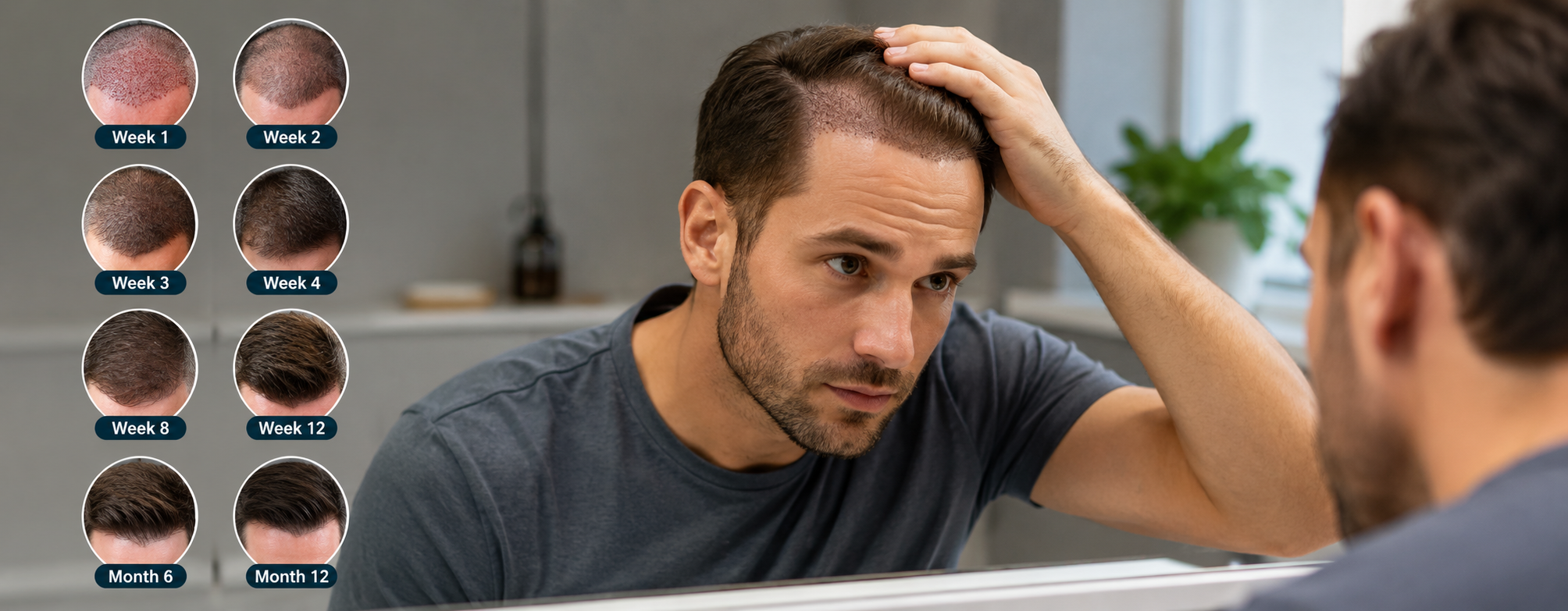
Hair Transplant Recovery Timeline: Week-by-Week Guide
Hair transplant surgery is widely recognized as one of the most effective and long-term solutions for hair loss or thinning. The procedure has undergone numerous improvements through modern techniques and technologies. Overall, the procedure has been delivering natural-looking results and a permanent solution for hair loss, particularly baldness.
While deciding about undergoing hair transplant surgery in Delhi, many patients often feel confused about the recovery time. How long recovery takes and when they can expect visible results after their procedure.
And it is absolutely normal yet crucial to understand the healing process because the results after hair transplant treatment are not instant. A scalp goes through several stages of recovery before new hair growth begins to become visible.
The recovery time after hair transplant surgery typically takes several weeks to months, with different changes occurring at each stage.
This blog discusses the hair transplant recovery timeline in detail.
What to Expect Immediately After a Hair Transplant?
As said above, the results after a hair transplant treatment in Delhi are not instant; it takes months to show noticeable results.
Right after the procedure, usually the first 24 to 48 hours are considered the most sensitive phase of recovery. During this time, the transplanted hair grafts are still settling into the scalp, making proper care essential.
It is absolutely normal to see mild swelling, redness, and small scabs around the transplanted area. While these scabs are a part of the natural healing process, it helps protect the newly implanted hair follicles. Feeling slight tightness or sensitivity in the scalp is also normal to see among some patients.
Doctors always provide detailed aftercare instructions, such as how to sleep, wash the scalp, and avoid touching or scratching the treated area to ensure maximum safety in the first few days.
While most patients can resume their light daily activities within a couple of days, you must avoid strenuous exercise, excessive sweating, and direct sun exposure.
Hair Transplant Recovery Timeline: Week-By-Week
The recovery after a hair transplant in Delhi is a long process. Here is what week-by-week recovery looks like:
Week 1: Initial Healing Phase
In the first week, you will see:
- The small scabs begin forming around the transplanted hair grafts.
- It is normal to see mild redness, swelling, or scalp sensitivity.
- Feeling tightness or tenderness in the donor area may occur.
- Gentle washing after a few days is what the doctor usually recommends.
- You must avoid touching, scratching, or rubbing the grafts.
Week 2: Scabs Start Falling Off
In the second week, you will see:
- The scabs gradually begin to shed from the transplanted area.
- A visible reduction in redness and irritation will be seen.
- The scalp may begin to look more natural.
- Mild itching may still exist, but your skin continues to heal.
- By this time, most patients can resume their normal daily activities.
Week 3–4: Shedding Phase (Shock Loss)
In weeks 3 and 4, you will see:
- Your transplanted hairs may begin to fall out, known as shock loss. There is nothing to worry about as it is a normal part of the process.
- Your hair follicles remain healthy beneath the scalp.
- Your scalp may begin to look similar to how it did before the transplant.
Month 2–3: Dormant Phase
By the time you reach the second or third month, you will see:
- There is very little hair growth.
- The hair follicles will enter a resting phase before new growth begins.
- The scalp may look fully healed.
- Note: You must keep patience even at this stage because visible results are not immediate.
Month 4–6: Early Hair Growth
In the sixth month, you will see:
- The new hair strands begin to grow.
- Your hair may initially appear thin or soft.
- You may see a gradual improvement in hair density.
Please note that the growth may still look uneven in the early stages.
Month 7–9: Noticeable Hair Growth
As you reach the ninth month, you will see:
- The hair becomes thicker and stronger.
- There will be a significant improvement in hair density.
- You will now be able to style your hair more easily.
- The transplanted hair will blend more naturally with existing hair.
Month 10–12: Final Results
This is the time when you can see your fully grown hair.
- You would be able to see your full hair transplant results during this stage.
- Hair texture and thickness may begin to appear more natural.
- The final hairline and density will become clearly visible.
Factors That Affect Hair Transplant Recovery
The hair transplant recovery is often influenced by different factors. These factors play a key role in influencing how quickly and smoothly a person can recover after a hair transplant in Delhi.
Undoubtedly, the general recovery timeline is similar for most patients. However, the recovery experiences can vary from person to person depending on a few important aspects.
- The type of hair transplant procedure performed is one of the key factors. For example, techniques such as Follicular Unit Extraction (FUE) usually involve smaller incisions. As a result, you may have a slightly faster recovery compared to other methods.
- The number of transplanted grafts is another factor that can affect the healing time. Procedures involving more grafts may require a longer recovery period.
- An individual’s natural healing ability, depending on age, overall health, and lifestyle habits, can also significantly influence the recovery after a hair transplant in Delhi.
- Last but not least, following post-care instructions given by your doctor plays a major role in the recovery process.
Conclusion
The recovery after hair transplant treatment in Delhi is a gradual process. The recovery can take over several weeks and months to show visible results. Though your scalp will heal in the first few weeks, visible hair growth takes time as transplanted follicles go through natural growth cycles. The key is to have patience, as it takes 9 to 12 months to achieve fuller and more natural-looking results. Additionally, following proper aftercare instructions and maintaining a healthy lifestyle are crucial to support healing and ensure the best outcomes.






Leave a Reply